
Arcagna nomeranza (cru)
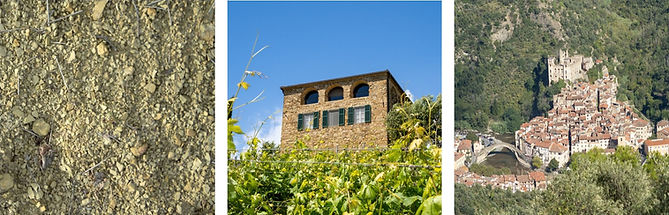
It is unquestionably one of the oldest cultivated places in Liguria. Archaeological finds on the northern slope of Arcagna suggest that the Ligurians were farming here in the 7th century BC. Blessed with enviable sunshine and a warm but never torrid climate (the Alps are close by), the area has never ceased to be cultivated: first by the Roman Aurinia family in the early centuries AD, then, from the 12th century, by the Benedictine monks of the Abbey of Novalesa, and finally by the people of Dolceacqua, in particular the Orrigo family, who built the farmhouse that is now the symbol of Terre Bianche.
Identity card
Soil type
Ventimiglia Flysch.
Details
The unit consists of turbidite sequences of alternating grey-brown sandstones and pelites. The formation is made up of coarse graded sandstones and fine sandstones in banks and beds, with silty-sandy and silty-clayey interbeds; clayey-marly and occasionally calcareous-marly levels are present.
Geological age
Eocene (Upper Bartonian–Lower Priabonian).
Average slope
30%.
Altitude
380-450 m.
Exposure
East.
Plantings
Varieties and planting year
Rossese di Dolceacqua, 1890, 2010, 2020.
Pigato, 1991.
Rootstocks
Rupestris du Lot, Paulsen 1103.
Training systems
Spurred cordon, Guyot.
Curiosities
Etymology
An ancient history, an ancient name: ‘arcagna’ is thought to derive from the Latin ‘loca arcanea’, meaning ‘enclosed, protected place’ or ‘place of boundary marks’. It was probably an estate controlled by the Roman Aurinia family.
History
Its position on the hilltop has made Arcagna a natural and political border: from the Ligurians’ wars of independence against the Greeks and Romans (first centuries BC) to the front line between Italy and France in the Second World War.
Literature
Mario Soldati writes about Arcagna in ‘Vino al Vino’ (1975): “the most exhilarating landscape one could imagine”.
In his 1990 ‘Repertorio’, Veronelli rated the Arcagna cru as “exceptional”.